
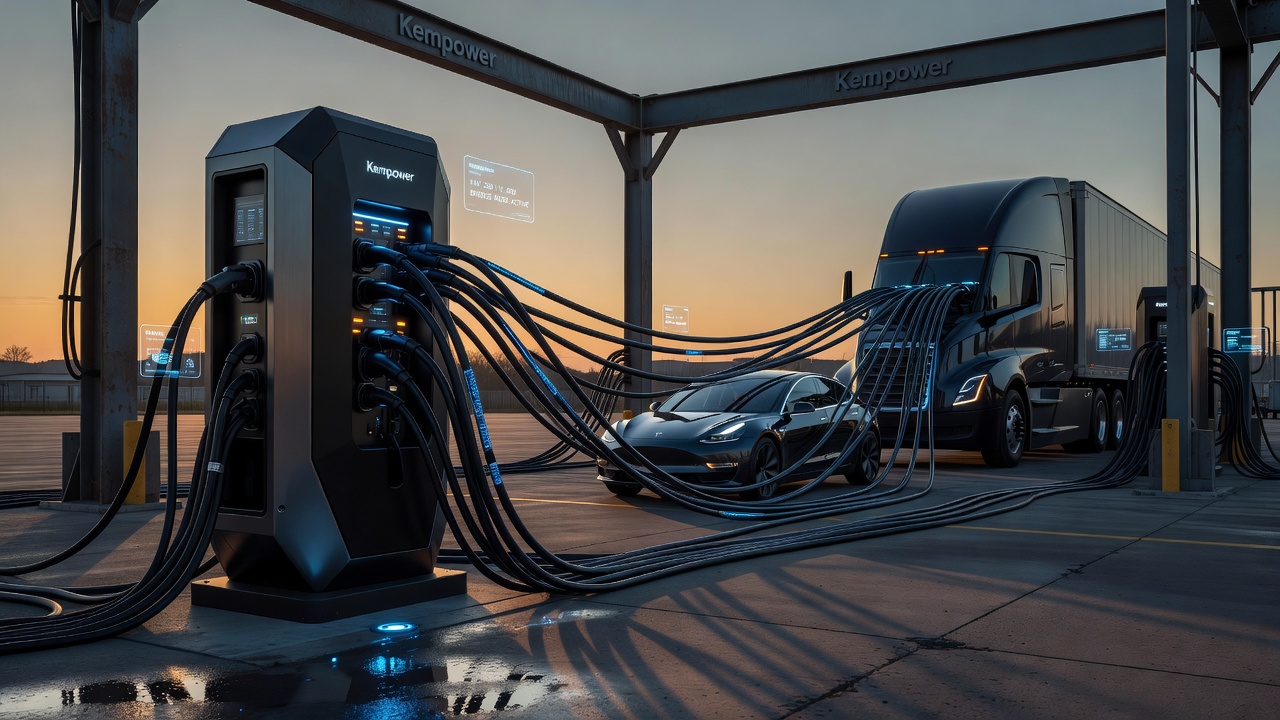
A single charging bay that can serve both a passenger sedan and an electric semi-truck sounds like a small engineering detail, but it addresses one of the costliest problems in building out fast-charging infrastructure. Kempower has unveiled the Mega Satellite Flex, a high-power dispenser that supports the established CCS standard at up to 560 kW and the emerging Megawatt Charging System at up to 1.2 MW. It is the Finnish company's first unit capable of switching between the two, and it arrives at a moment when charging network operators are trying to avoid building redundant infrastructure for different vehicle classes.
The timing reflects a broader shift in how electric transport is evolving. CCS has been the backbone of passenger EV charging for years, but it was never designed for the power demands of heavy-duty trucks, which need to recharge large battery packs quickly to stay commercially viable. MCS was developed specifically to meet that need, and its rollout is now gathering pace alongside electric truck production. For consumers weighing whether an EV subscription service or a private charging arrangement makes financial sense, comparing running costs against something as ordinary as what a monthly plan costs for a streaming or software service can put the economics of fast charging into perspective - infrastructure costs eventually filter down into what drivers and fleets pay per session. what a monthly plan costs
Operators face a genuine dilemma when planning new sites: build for today's passenger EVs, tomorrow's electric trucks, or both at once. Constructing separate stations for each vehicle type doubles land use, permitting effort, and grid connection costs. A dispenser that handles both standards from a single cabinet changes that calculation, letting a site owner serve current traffic while staying ready for heavier vehicles without a second phase of construction.
Why Power Levels and Cable Design Matter
The technical specifications behind the Mega Satellite Flex reveal how demanding megawatt charging actually is. The unit supports up to 1,500 amps on the MCS side and 700 amps for CCS, current levels that require thicker cabling, active cooling, and more robust connectors than typical passenger charging equipment. Cable length matters too: the CCS cable extends five meters, while the MCS cable is shorter at 2.7 meters, a difference that reflects how truck charging ports are positioned and how drivers need to maneuver large vehicles into position. An optional payment terminal allows the unit to function as a standalone commercial charging point rather than requiring a separate kiosk.
The charger also supports 800-volt vehicle architectures, an increasingly common design in newer EVs that allows for faster charging without excessive current. Pairing high voltage with high current is what makes megawatt-level charging speeds possible at all, and hardware that can flex between voltage and current profiles is becoming a baseline requirement rather than a premium feature.
Fitting Into Existing Charging Networks
Kempower designed the Mega Satellite Flex to work with its existing distributed charging architecture, meaning operators who already run Kempower installations can add the new unit without reworking their entire setup. That compatibility matters commercially: infrastructure buildouts are capital-intensive, and any charger that requires a parallel system tends to face slower adoption. A unit that slots into current deployments lowers the barrier for site owners weighing whether to serve trucking corridors, logistics hubs, or mixed-use travel stops.
The announcement came during Kempower's Unplug & Recharge event at ACT Expo, where the hardware is on display this week. The company expects the Mega Satellite Flex to reach the North American and European markets in July 2026, giving fleet operators and charging network developers roughly a year to factor the technology into site planning as the electric trucking sector continues its buildout.